

Table of Contents
- Why Durability Defines Professional Lock Picking Tools
- Metallurgy and Durability Testing: What Actually Breaks
- Durable Lock Pick Sets and Modular Kits
- Professional Locksmith Tool Belt Essentials
- Ergonomics and Long-Term Hand Fatigue
- Pen-Style Lock Pick Tool: Discreet EDC for Field Work
- Lock Pick Tool Maintenance and Legal Compliance
- Frequently Asked Questions
Last Updated: October 9, 2026
Why Durability Defines Professional Lock Picking Tools
A lock pick that bends on the first stubborn pin isn't a tool, it's a liability. At Dyno Kwick Pick, the answer comes down to material and design, not marketing claims.

This guide breaks down what fails, what holds up, and which specs matter.
The U.S. Bureau of Labor Statistics tracks locksmith and security technician employment as a skilled trade, and the reality of that trade is simple: your tools take abuse.
Metallurgy and Durability Testing: What Actually Breaks
Most guides tell you to "look for quality steel" and stop there. That advice is useless when you're standing in front of a seized commercial mortise cylinder at 11 p.m.
Lock picks fail in three predictable ways: the tip snaps, the shaft bends, or the handle cracks at the joint. Each traces back to a specific material decision worth inspecting before you buy.
Steel Grades That Matter for Pick Blades
The stainless steels used in quality pick blades fall into two families.
Austenitic grades (300 series, commonly 301 and 302). These are the workhorses of the pick world.
Carbon steel (commonly 1075 or 1095). Hard, takes a keen edge, cheap to produce. It also rusts quickly and loses temper if overheated during grinding.
Aluminum. Light, corrosion-resistant, and far too soft to serve as a pick blade.
Hardness, Temper, and Why 'Harder' Isn't 'Better'
A common misconception is that harder steel makes a better pick. It doesn't. Hardness and toughness pull in opposite directions.
For pick blades, most practitioners find the sweet spot in the mid-to-high 40s on the Rockwell C scale, paired with a spring temper that lets the steel return to true after flexing.
Case hardening carburizes the outer skin of a low-carbon steel part while leaving the core soft and ductile, producing a wear-resistant surface with a shock-absorbing interior.
How Professionals Actually Test Durability
You don't need a lab to evaluate a pick, just a repeatable routine.
- Flex test. Clamp the handle, apply steady lateral pressure to the tip, and release. A properly tempered blade returns to true; one that stays bent was over-hardened or under-tempered.
- Tip inspection under magnification. A 10x loupe reveals stress marks, micro-cracks, and rolled edges the naked eye misses. Inspect after every heavy raking session.
- Torsion cycle test. On a practice lock, apply tension to the wrench and hold it for 30 seconds, then release. Repeat. A wrench that develops a permanent twist is too soft; one that chips at the tip is too hard.
- Corrosion check. Wipe a blade with a damp cloth, leave it overnight, and look for surface discoloration. Any steel that pits overnight needs a coating or a different alloy.
| Failure Mode | Common Cause | Material Fix |
|---|---|---|
| Tip snaps | Over-hardened steel, no temper | Mid-40s HRC spring-tempered stainless |
| Shaft bends permanently | Under-hardened or over-tensioned | Work-hardened 301 or 302 stock |
| Handle cracks | Weak joint, mismatched materials | Solid housing, matched thermal expansion |
| Rust and pitting | Carbon steel, no coating | 300-series stainless or polished finish |
| Wrench twists | Too soft for torsion load | 400-series or through-hardened alloy |
Durable Lock Pick Sets and Modular Kits
A durable lock pick set earns its place by covering the profiles you actually use without carrying dead weight.
The hook pick handles single-pin manipulation. The rake, especially a snake rake, opens easily raked pin tumbler and wafer locks fast.

Replacement parts keep a kit alive for years. The Replacement Snake Rake is stainless steel at 0.032", and the Replacement Tension Wrench uses a tapered steel design that fits many locks.

Professional Locksmith Tool Belt Essentials
A professional locksmith tool belt essentials list starts with the tools you reach for on every call, not the ones you use twice a year.
Here's what belongs on the belt:
- A pen-style pick or compact pick set for fast entry
- At least two tension wrenches in different thicknesses
- A snake rake for quick raking jobs
- A broken key extractor for extraction calls
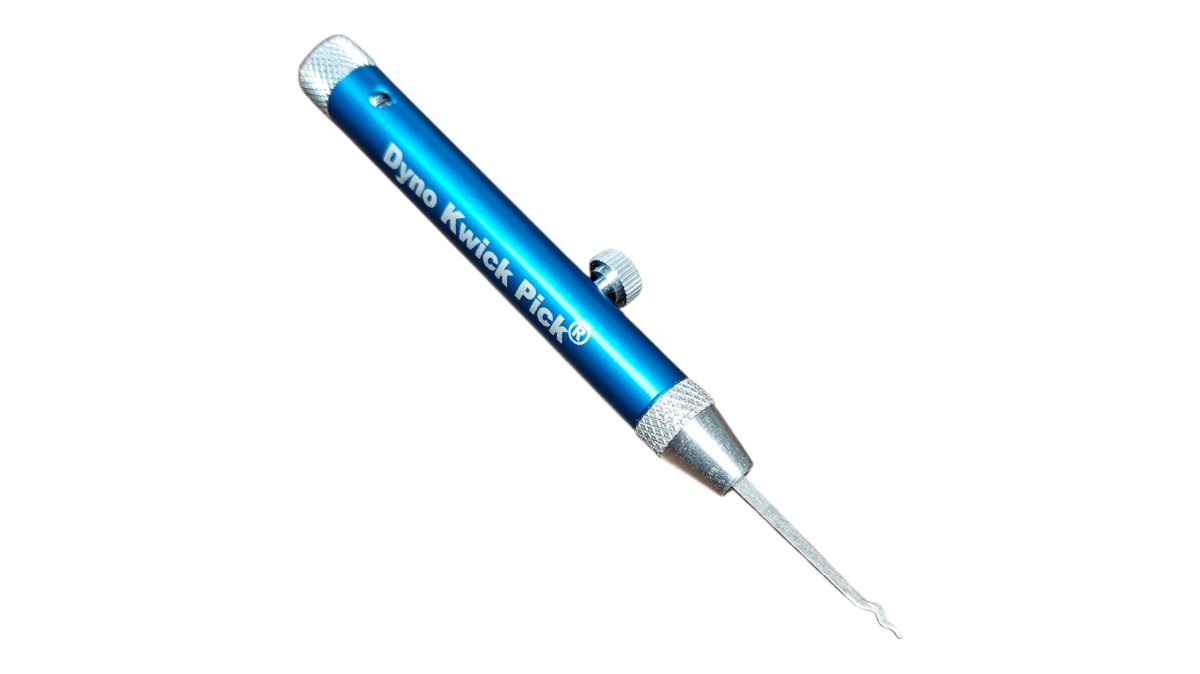
The Dyno Kwick Pick fits this list well: a pen-style 3-in-1 tool with a snake rake and tension wrench built in, plus a pocket clip so it sits on the belt or in a pocket without announcing itself.
The Kwick Pick Attachment Cap adds a D-ring, paracord, or key ring anchor for $4.99, solving the "where did I put it" problem that plagues small tools.
Ergonomics and Long-Term Hand Fatigue
Hand fatigue is the durability issue nobody talks about, because it's your hands that wear out, not just the steel.
A tool that forces an awkward grip costs you accuracy by the end of the day, and accuracy separates a fast open from a damaged lock.
The Biomechanics of a Pick Grip
Three factors determine how much strain a tool puts on your hand over a shift: grip diameter, weight distribution, and wrist angle.
Weight distribution. A top-heavy tool forces the wrist to work against gravity with every small movement.
Wrist angle. The neutral wrist position, where the hand and forearm form a nearly straight line, is the position of least strain on the carpal tunnel.
Vibration, Feedback, and the Case Against Over-Damping
Some manufacturers market vibration-dampening handles as an ergonomic upgrade. For lock picking, that claim deserves scrutiny. The tactile feedback transmitted through the pick is the primary information channel a locksmith uses to feel pin states, set points, and binding order.
The goal is not to eliminate feedback but to filter the right frequencies. A rigid connection between your fingers and the pick blade preserves the high-frequency information from the pins.
Practical Fatigue Management on the Job
Ergonomics is not just about the tool. How you use it matters as much as what you use.
- Rotate your grip between locks. Holding one static position concentrates pressure on the same tendons; shifting slightly spreads the load.
- Use the lightest effective tension. Gripping harder as a lock resists sends tension straight into your forearm and reduces the feedback you need. Lighter, controlled pressure gets better pin response and saves your hands.
- Alternate hands when possible. Even brief switches give the dominant hand recovery time.
- Stretch between calls. Wrist flexor and extensor stretches take thirty seconds and measurably reduce end-of-day soreness.
Pen-Style Lock Pick Tool: Discreet EDC for Field Work
A pen-style lock pick tool is a compact pick designed to look and carry like a pen, making it a natural fit for everyday carry.
The Dyno Kwick Pick has been around for over 25 years and is designed and tested by professional locksmiths.
For everyday carry, the pen-style form factor beats a bulky roll-up kit: it clips to a pocket, fits in a tool pouch, and doesn't raise questions in a client's building.
Lock Pick Tool Maintenance and Legal Compliance
Lock pick tool maintenance is simple but easy to skip, and skipping it is how good tools die early. Wipe down steel parts after use, keep them dry, and store them so the tips aren't banging against each other.
Inspect tips regularly under good light. A slightly bent tip is a warning sign, and a cracked one will fail at the worst moment.
Legal and Ethical Compliance for Professionals
Lock picking laws vary by state, and some states restrict possession of lock picking tools to licensed professionals or require specific circumstances. Before you carry tools on a job, check your state statutes and local ordinances. Working as a licensed locksmith with documented authorization is a very different legal position from carrying picks with no legitimate purpose.
Ethically, the standard is straightforward: only open what you're authorized to open, verify ownership or authorization before you start, and keep records of service calls. Professionals who treat that seriously protect both their license and their reputation.
A practice lock helps you build skill without touching a client's hardware. The Dangerfield Repinnable Practice Lock Kit includes 30+ security pins and a 6-pin mortise cylinder, so you can practice progressive difficulty from one pin up to a full six-pin configuration with spool and serrated pins. The Dangerfield Aluminum Cutaway Practice Lock lets you see and feel exactly how tension affects each pin, shortening the learning curve significantly.
Frequently Asked Questions
What should professionals look for in a durable lock pick set?
Prioritize material and feedback over piece count. Stainless steel picks at 0.032 inch thickness resist bending during heavy torsion, and a tapered tension wrench that fits a wide range of keyways prevents slippage. A modular kit with replaceable parts, like a $5.99 replacement tension wrench or a $6.99 snake rake, extends the life of the set. Look for corrosion-resistant finishes and a handle that reduces hand fatigue during long jobs.
Which materials are commonly used for professional lock picks?
Stainless steel is the standard for picks and rakes because it resists corrosion and holds shape under torsion. Carbon steel offers higher hardness but can rust without a protective finish. Aluminum appears in handles and pen-style bodies, as with the Dyno Kwick Pick, which uses a polished, corrosion-resistant aluminum body. Case hardening on steel picks improves wear resistance at the tip where contact with pin tumblers is most aggressive.
Are individual lock picks or complete sets better for locksmiths?
It depends on call volume. A complete set covers hook, diamond, and rake profiles for different keyways, but many locksmiths carry a smaller modular kit and replace worn pieces individually. The Dyno Kwick Pick pairs a snake rake and tension wrench in one pen-style tool for $20.50, and replacement parts cost $4.99 to $6.99. For daily field work, a modular setup with spares is more practical than a large set with unused profiles.
How should locksmiths store and maintain lock picking tools?
Wipe picks with a dry cloth after each job to remove metal dust and moisture, then store them in a dry case or pouch. Check tension wrenches for bends and replace them when torsion feels inconsistent. For pen-style tools, keep the cap secured; the Kwick Pick Attachment Cap at $4.99 adds a D-ring or key ring anchor to prevent loss. Inspect pick tips monthly for nicks that alter feedback and replace worn rakes before they fail on a call.
Are pen-style lock pick tools suitable for professional use?
Yes, when the tool matches the job. A pen-style lock pick tool like the Dyno Kwick Pick fits in a pocket, operates discreetly, and includes a snake rake and tension wrench for fast raking on pin tumbler and wafer locks. It is not a replacement for a full pick set on high-security cylinders, but for quick non-destructive entry on standard residential locks, it saves time. The aluminum body resists corrosion and the pocket clip keeps it accessible.
Durable lock picking tools for professionals come down to material, design, and how you treat them between jobs. Cheap picks cost more over time because you replace them constantly, while a well-built tool like the Dyno Kwick Pick carries for years. Our pen-style 3-in-1 design is made in the USA, trusted by locksmiths for over 25 years, and built for fast, discreet, non-destructive entry. Get started with Dyno Kwick Pick and carry a tool that holds up to daily field work.
0 commentaire