

Table of Contents
- Why Lock Picks Bend: The Physics Behind Tool Failure
- Material Quality and Metallurgy: Why Cheap Picks Fail
- Pick Profile, Taper, and Thickness: Design Factors That Matter
- Lock Picking Tension Techniques That Protect Your Tools
- How to Prevent Broken Lock Picks: A Visual Diagnostic Guide
- Common Beginner Mistakes That Bend Picks
- Choosing a High Quality Lock Pick Set and Repairing Bent Picks
- Frequently Asked Questions
Last Updated: October 2, 2026
Why Lock Picks Bend: The Physics Behind Tool Failure
A lock pick bends when the force you apply exceeds the metal's yield strength, and the tool stays deformed instead of springing back. This guide from Dyno Kwick Pick explains why lock picks bend, and how to stop it. Every pick has a limit, understanding it is the difference between a tool that lasts years and one that snaps in a month.

Three forces work against your pick at once:
- Tension from the wrench, which twists the plug
- Torque from your turning hand
- Use from the pick shaft against the keyway
Yield Strength and Plastic Deformation
Yield strength is the point where a metal stops bending and starts staying bent. Below it, the pick springs back; above it, the change is permanent. Engineers call that plastic deformation, once it happens, the pick never returns to its original shape. The bend you see is the metal telling you it was pushed too far.
Stress Concentrations at the Shaft and Tip
Stress doesn't spread evenly across a pick. It piles up at sharp corners, narrow necks, and the tip, spots engineers call stress concentrations. A pick usually fails at its thinnest point, not its weakest alloy, which is why the tip and the shaft near the handle bend first.
Material Quality and Metallurgy: Why Cheap Picks Fail
Metal quality decides how much abuse a pick survives. Low-grade steel with poor heat treatment bends at forces a quality tool shrugs off, a cheap pick may feel fine for a week, then take a permanent curve that ruins your feedback.
Stainless Steel Grades and Heat Treatment
Not all stainless steel is equal, grade and heat treatment decide the balance of hardness and flexibility. Most quality lock picks come from one of three families:
-
301 stainless steel, a high-chromium, austenitic alloy that work-hardens rapidly when cold-rolled. It offers excellent springback and corrosion resistance, which is why it dominates the premium pick market. Its yield strength in the cold-worked condition can exceed 200,000 psi, meaning it resists permanent deformation under normal picking loads.
-
302 stainless steel, similar chemistry to 301 but with slightly lower carbon and a different cold-roll schedule. It is softer, easier to form, and cheaper. Picks made from 302 tend to take a set (a permanent bend) at lower force than 301.
-
Carbon steel (often 1075 or 1095), higher hardness potential and better wear resistance, but it rusts without a coating and can be brittle if tempering is rushed. Some budget sets use it because it is inexpensive to stamp and heat-treat.
-
Too soft: the pick bends under light pressure
-
Too brittle: the pick snaps instead of flexing
-
Properly tempered: the pick flexes and returns to shape
How Work Hardening and Fatigue Cause Micro-Fractures
Every bend stresses the metal, even the ones that spring back. Repeated stress causes work hardening, where the metal gets harder and less flexible over time, in 301 stainless this happens quickly, since the alloy is designed to gain strength as it is cold-formed. Keep bending it and tiny micro-fractures form, spreading with each use until the pick fails, often with no warning.
The distinction matters for diagnosis:
- Work-hardened bend, the metal has yielded and taken a permanent set. The bend is smooth, the surface is intact, and the pick still flexes at other points. This is a ductile failure.
- Fatigue-induced micro-fracture, the metal has cracked at a stress concentration. The bend may look small, but the surface shows a hairline crack or a rough, granular texture at the bend. This is a brittle failure and the pick is close to snapping.
Pick Profile, Taper, and Thickness: Design Factors That Matter
Design decides how a pick handles force before the metal even matters. Pick profile, taper, and thickness all change how stress moves through the tool.
How Pick Thickness Affects Springiness and Durability
Thickness is a trade-off: thicker picks resist bending but feel stiff and clumsy in tight keyways, while thinner picks give great tactile feedback but bend easily. Springiness, the ability to flex and return, comes from thickness, taper, and heat treatment combined. Get all three right, and the pick feels alive in your hand.
Lock Picking Tension Techniques That Protect Your Tools
Good lock picking tension techniques protect the pick as much as they speed up the open. Most bending happens because of too much tension, not too much picking.
How Much Tension Is Too Much?
Use just enough tension to hold set pins, and no more. If you're pressing hard on the tension wrench, you're using too much.

Signs your tension is too heavy:
- The pick feels like it's binding
- Pins won't set no matter what you do
- You're pushing instead of feeling
How to Prevent Broken Lock Picks: A Visual Diagnostic Guide
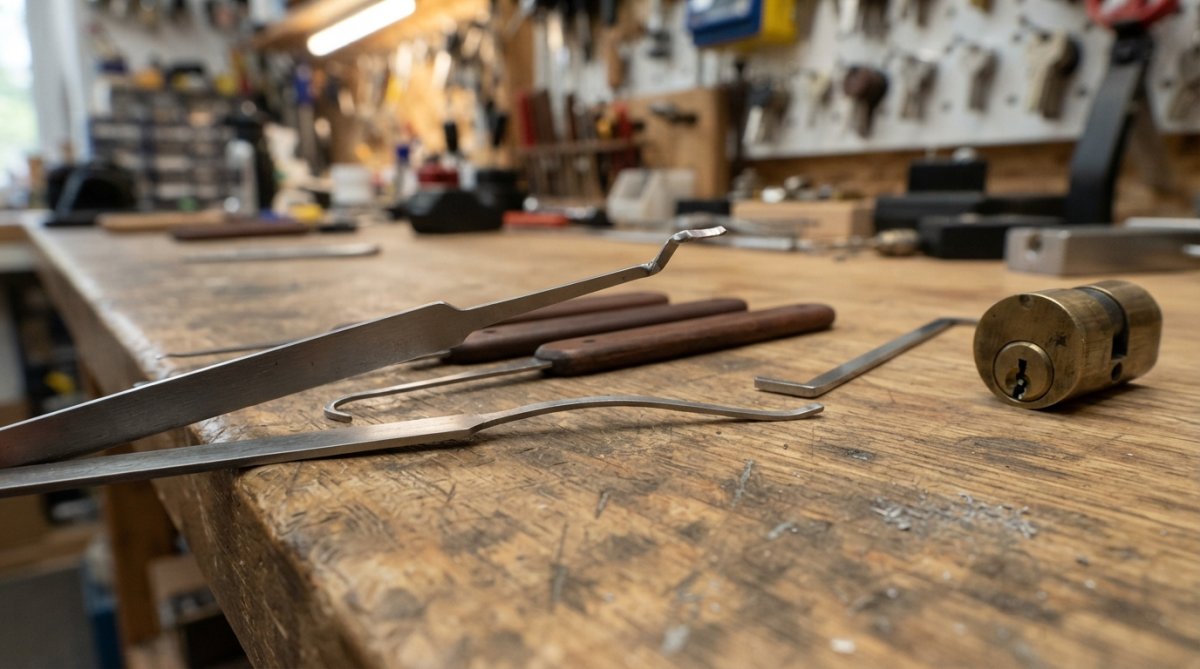
Preventing broken lock picks starts with reading the tool. Your pick shows you its stress before it fails, if you know what to look for. This section gives you a visual diagnostic framework that goes beyond 'it bent, so replace it', not all bends are equal, and some are warnings while others are already failures.
Reading Bend Patterns: What Your Pick Is Telling You
The location of the bend tells you what went wrong. Use this table to diagnose the problem.
| Bend Location | Likely Cause | Fix |
|---|---|---|
| Tip curls up | Too much torque on the rake | Lighten tension, slow down |
| Shaft bows near handle | Excessive use | Grip closer to the keyway |
| Slight curve along length | Repeated overstress | Replace the pick |
| Sharp kink at neck | Stress concentration | Switch to a stronger profile |
Work-Hardened Bend vs. Fatigue Micro-Fracture: A Visual Checklist
A bend is not the same as a crack. Before you straighten or reuse a pick, inspect it under bright light and, if possible, a magnifying glass:
Work-hardened bend (ductile):
- Smooth, gradual curve with no sharp angles
- Surface is shiny and continuous, no lines, no discoloration
- The pick still flexes at other points along its length
- You can feel the bend with your fingers but not catch a fingernail on it
Fatigue micro-fracture (brittle):
- Sharp kink or crease at the bend point
- Hairline crack visible under magnification, often running perpendicular to the pick's length
- Rough, granular, or dull texture at the bend, like torn metal rather than stretched metal
- A fingernail catches on the surface
- The pick feels stiff or 'dead' when flexed
Tension Wrench Thickness and Pick Thickness: The Leverage Relationship
Most guides treat tension and picking as separate skills, but the thickness of your tension wrench and your pick interact to determine how much leverage you apply, and how much bending force reaches the pick. A thin tension wrench (common in budget sets) flexes under pressure, so you press harder with your tension finger; that extra force transfers through the lock body and into the pick as lateral load.
Ergonomic Impact: How Grip Pressure Becomes Bending Force
Handle design and grip pressure contribute to unintentional force more than most pickers realize. A handle that is too small forces you to pinch hard, and that pinch pressure travels down the shaft as a bending moment; too smooth makes you grip tighter to avoid slipping; too heavy or unbalanced pulls the pick off-axis, so you correct with your wrist and add lateral load.
- A handle diameter that fills your hand without stretching your fingers
- A textured or contoured surface that reduces the need for pinch force
- A weight balance that keeps the pick level in the keyway without wrist correction
Common Beginner Mistakes That Bend Picks
Beginners bend picks for predictable reasons. Fix the habits, and the tools last:
- Cranking the tension wrench like a doorknob
- Using the pick as a lever instead of a feeler
- Raking a lock that needs single-pin picking
- Ignoring a small bend until it becomes a big one
- Buying the cheapest set and blaming technique
Choosing a High Quality Lock Pick Set and Repairing Bent Picks
A high quality lock pick set prevents most bending before it starts. Good steel, proper heat treatment, and smart profiles all pay off.
Straightening a Bent Pick Without Making It Worse
Straightening a pick is possible, but risky. Every bend weakens the metal a little more.
If you must straighten one:
- Support the pick flat on a hard surface
- Apply slow, even pressure with your fingers
- Never use pliers or sharp tools
- Check for cracks before you use it again
- Retire the pick if it kinks a second time
Frequently Asked Questions
How much tension should be applied when picking a lock?
Use only enough tension to feel the binding pins set, roughly the pressure you would use to hold a piece of paper against a wall. Excessive tension is the leading cause of bent picks because it forces the pick to fight the lock instead of manipulating it. Start light, increase gradually, and let tactile feedback guide you. If the pick feels like it is flexing more than the pins are moving, back off the tension wrench immediately.
What are common lock picking mistakes that damage tools?
The most common mistakes include using too much torque on the tension wrench, raking with force instead of finesse, and using a pick that is too thin for the lock's keyway. Other culprits are twisting the pick sideways inside the cylinder and applying pressure at the tip instead of the shaft. Each of these concentrates stress at the weakest point of the tool, which is usually where the pick meets the handle or at the first bend of the profile.
Is it illegal to own a lock pick set?
Legality varies by state and locality. Some states allow possession with no restrictions, while others require a locksmith license or limit ownership to certain professions. A few states prohibit possession outright unless you fall into an exempt category. Before buying any lock pick tool, check your state and local statutes. Many sellers also require a signature or proof of professional use at checkout. Knowing the rules protects you and keeps the hobby or trade legitimate.
How can I tell if my lock pick is about to break?
Watch for three warning signs: a visible curve in the shaft that was not there when new, a tip that no longer sits flat against the pin, and a change in springiness where the pick feels softer or more flexible. These indicate plastic deformation or micro-fractures from fatigue. Once a pick has bent and been straightened, its yield strength drops and it will bend again more easily. Replace it rather than risk a break inside a lock.
Bent picks are a technique problem far more often than a metal problem. Fix your tension, respect the tool's limits, and most picks will outlast their owners. When you're ready for a pick built to handle daily use, the Dyno Kwick Pick offers a durable, American-made design with a snake rake and tension wrench in one discreet pen-style tool. Get started with Dyno Kwick Pick and carry a tool that holds its shape.
0 commentaire