

Last Updated: October 30, 2026
Quick Summary
A good lock picking collection starts with one durable starter pick set, a clear practice lock, and simple storage, then grows in stages as your skill improves. Buy each stage only after you can open your current locks consistently. Most beginners spend roughly $40 to $85 on the first tier.
- Start with a starter pick set of 8 to 12 pieces, priced about $20 to $40.
- Add one clear practice lock with standard pins, priced about $15 to $30, to watch pins move.
- Move to a progressive set with spool and serrated pins once simple locks feel routine.
- Store picks flat in a labeled pouch or case, and keep tension wrenches separate to avoid nicks.
- Buy the next stage only after you can open your current locks consistently.
Table of Contents
- What a Lock Picking Collection Needs to Do
- Choosing Your First Beginner Lock Pick Set
- Building Your Practice Lock Collection
- A Skill-Level Plan for Growing Your Collection
- Budget Tiers and Total Cost of Ownership
- How to Organize Lock Picks and Care for Your Tools
- Practice Tips, Common Mistakes, and Legal Boundaries
- Booking Your Next Pick: Choosing Your Starter Tools Today
- Frequently Asked Questions
What a Lock Picking Collection Needs to Do
Most beginners buy one kit, practice for a month, and wonder what's next.
A useful collection does three jobs: teach the basics, provide practice locks that match your level, and keep tools in good shape so they last.
- Teach: Starter tools and clear practice locks let you see how pins move.
- Challenge: Locks with security pins push you once the basics feel easy.
- Last: Good storage keeps picks straight, clean and ready to use.
Lock picking is a skill that builds on itself. Your collection should follow the same path.
Choosing Your First Beginner Lock Pick Set
Your first set matters more than any tool you buy later. A good starter set covers the basic tool types and gives enough variety to find what feels natural. Many beginners buy large kits and never use most of the picks; a smaller, well-made set usually teaches faster.
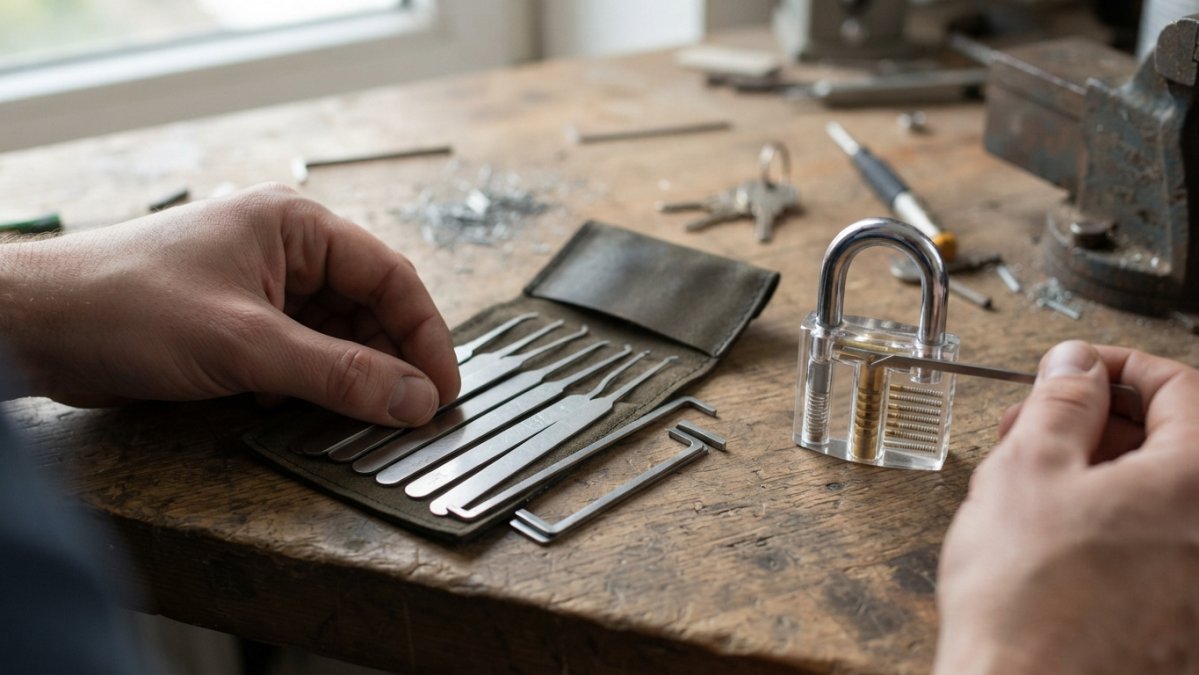
Essential pick and tension tool types
Most beginners need only a few core tools to start. These are the ones to look for:
- Tension wrench: Applies light rotational pressure to the plug. This is the tool that makes the pins bind.
- Hook pick: Lifts pins one at a time. It is the main tool for single-pin picking.
- Rake pick: Bounces several pins at once. Useful for quick practice on simple locks.
A tension wrench is the most important tool in any set. Without steady tension, pins will not set no matter how well you pick.
What to check in a starter set
Before you buy, look at what is actually in the box. Check these points:
- Clear tool labeling, so you know which pick is which
- Tool durability, such as a solid metal build
- A case or pouch that keeps the picks organized
A pen-style 3-in-1 lock pick tool is a compact, discreet option for beginners. Dyno Kwick Pick's version is made in the USA.
Building Your Practice Lock Collection
Real locks are a poor place to learn. Clear practice locks let you watch the pins move, and that feedback speeds up learning. Build your practice collection in the same order you build your skills.
Starting with simple pin-tumbler locks
Pin-tumbler locks are the standard starting point: pins are easy to see and binding order is predictable.
A repinnable cutaway practice lock is a good next step. The Dangerfield Repinnable Practice Lock, priced at $69.99, lets you swap pins to build your own difficulty. Find it here: practice lock kit for beginners.

Progressing to security pins
Once simple locks feel routine, move to security pins, spool and serrated pins that create false sets and counter-rotation. Practicing on them early helps.
A clear progressive set is useful here. Browse the set: progressive clear practice locks.

For a deeper look at the mechanics, the Lock Picking Book by Dyno Kwick Pick ($24.99) includes over 190 color illustrations showing what happens inside the lock.
A Skill-Level Plan for Growing Your Collection
Think of your collection in three stages. You do not need everything at once. Buy each stage when you are ready for it.
- Stage 1, Beginner: One starter tool set and one simple clear practice lock. Focus on tension control and single-pin picking.
- Stage 2, Intermediate: A progressive practice set with security pins, plus a compact tool for practice on the go.
- Stage 3, Advanced: A repinnable kit for custom pin combinations, plus a reference book for tougher mechanisms.
Move to the next stage only when you can open your current locks consistently. Rushing ahead leads to frustration and wasted money.
Budget Tiers and Total Cost of Ownership
Most beginner guides say "buy quality" and stop there, useless at checkout with three kits in your cart. This section breaks the collection into three budget tiers with itemized costs, then shows how total cost of ownership changes the math over two to three years.
Tier 1: Starter collection (under $100)
The goal of this tier is to confirm you enjoy the hobby before spending real money. You need one durable tool set and one lock you can see inside.
- Starter pick set: $20-$40. Look for 8-12 pieces with at least two tension wrenches in different thicknesses, a standard hook, a rake, and a diamond pick. Smaller sets are often easier to learn with than very large kits.
- Clear practice lock: $15-$30 for a single cutaway lock with standard pins.
- Storage: $5-$15 for a roll-up pouch or hard case.
Tier 1 total: roughly $40-$85. A $25 set that lasts two years beats a $12 set that bends in a month. Thin, soft metal picks deform at the tip, and a bent hook teaches bad technique because it no longer lifts pins evenly.
Tier 2: Intermediate collection ($100-$250)
Once you can consistently open a standard-pin lock, add security pins and a reference source. This is where most learners either progress fast or stall out buying redundant tools.
- Progressive practice set: $49.99 for the 3 Clear Progressive Locks (standard, spool, serrated).
- Reference book: $24.99 for the Lock Picking Book with over 190 color illustrations. Pair it with the progressive set.
- Second tension wrench thickness: often included, but budget $8-$15 if your starter set had only one.
Tier 2 total: roughly $85-$140 on top of Tier 1, bringing cumulative spend to about $125-$225.
Practice Lock, Repinnable, Progressive, Aluminum, Cutaway Training →
Tier 3: Advanced collection ($250-$400+)
This tier is for hobbyists who want to build custom pin configurations and train on demand.
- Repinnable practice lock: $69.99 for the Dangerfield Repinnable Practice Lock, or $47.99 for the Repinnable Practice Lock Kit with more than 30 pins. The kit is the better long-term value if you reconfigure often.
- Spare pin assortment: $15-$30 for extra standard, spool, and serrated pins.
- Advanced reference material and a second lock body: $30-$60.
Tier 3 total: roughly $115-$160 on top of Tier 2, for a full collection in the $250-$400 range.
Total cost of ownership: why cheap costs more
A $12 pick set that bends after 20 sessions costs $12 plus a $25 replacement plus lost practice time relearning feel. A $35 set that lasts three years costs about $12 per year. The same logic applies to practice locks: a $15 lock with non-replaceable pins becomes useless once you master standard pins, while a $47.99-$69.99 repinnable lock stays useful for years.
What not to buy early
- Electric pick guns: they can mask technique and do less to build feel.
- Large "master" kits with 30+ picks: you will use 6-8 of them.
- Locks without a known pin configuration: if you cannot identify the pins, you cannot diagnose why a lock will not open.
Spend in the order the tiers are listed. Each tier assumes you have mastered the previous one, so buying Tier 3 tools before you can open a spool-pin lock just moves money from your account to your shelf.
Here is how the three budget tiers compare on cost and what each one includes.
| Tier | Typical cost | Key contents |
|---|---|---|
| Tier 1: Starter | $40-$85 total | Starter pick set $20-$40, clear practice lock $15-$30, storage $5-$15 |
| Tier 2: Intermediate | $85-$140 added | Progressive set $49.99, reference book $24.99, optional travel tool |
| Tier 3: Advanced | $115-$160 added | Repinnable lock $69.99 or kit $47.99, spare pins $15-$30 |
How to Organize Lock Picks and Care for Your Tools
A lock picking collection is only as good as its weakest pick. A hook with a slightly rolled tip still opens locks, but it lifts pins unevenly and teaches you to compensate for a tool defect instead of correcting your technique. This section covers storage, cleaning, inspection, and inventory so your collection stays accurate.
Storage: flat, dry, and labeled
Picks are thin spring steel. They bend when stored loose in a drawer or jammed into a soft pouch tip-first.
- Use a roll-up pouch or hard case with individual slots. The slot holds each pick flat and keeps the tip off hard surfaces.
- Store tension wrenches separately from picks. Their right-angle bends catch pick tips and nick them.
- Keep a silica gel packet in the case in humid climates. Moisture causes surface rust on carbon-steel picks.
Cleaning and corrosion prevention
Picks pick up skin oils, lock lubricant, and graphite. Left on the metal, these trap grit that wears the tip.
- Wipe each pick with a dry cloth after every session. A microfiber cloth works well and does not leave lint.
- For sticky residue, use a small amount of isopropyl alcohol on a cloth, never soak the pick or handle.
- Apply a thin coat of light oil every few months to carbon-steel picks, then wipe off excess. Stainless picks need this less often.
Inspecting and replacing worn tools
Check your most-used picks, usually the standard hook and your primary tension wrench, every few weeks.
- Look for a rolled or rounded tip. A hook should have a distinct lifting edge; a polished, rounded tip is worn.
- Check for a bend along the shaft. Lay the pick on a flat surface; any gap means it is bent.
- Retire worn picks from practice, not from the case. A worn hook still works for raking, but should not be your primary single-pin tool.
Lubricating practice locks
Practice locks collect dust and dried lubricant in the pin chambers. When pins start to stick or feel gritty:
- Apply one or two drops of light liquid lubricant into the keyway and work the pins with a pick or key for a minute.
- Wipe away excess lubricant from the keyway face so it does not attract dust.
- For repinnable locks, clean the pin chambers with a dry cloth each time you swap pins. Old lubricant plus metal dust causes sluggish pin movement.
A simple inventory and upgrade checklist
Keep a one-page list, paper or spreadsheet, with these columns: tool or lock, type, date acquired, condition (good/worn/retired), and next action. Review it before every purchase.
Use this decision checklist before buying anything new:
- Do I already own a tool that does this job? If yes, do not buy a duplicate.
- Have I mastered the lock type this tool is meant for? If no, buy practice time, not gear.
- Does this replace a worn tool or add a new capability? Replacements are justified; novelty additions usually are not.
- Will I use it at least monthly? If not, it belongs on a wish list.
An organized, clean, inventoried collection is easier to grow deliberately. You will know which pick is worn, which lock you have outgrown, and which purchase actually moves your skill forward.
Practice Tips, Common Mistakes, and Legal Boundaries
Practice regularly, even if it is only 15 minutes a day. Short, steady sessions build feel faster than long, rare ones.
Another frequent mistake is skipping ahead too fast. Master one lock type before moving on.
Lock picking is generally a legal hobby in the United States, but the rules vary by state and locality.
Booking Your Next Pick: Choosing Your Starter Tools Today
Start small, practice on the right locks, and grow your collection in stages. Begin with a solid starter tool set and one clear practice lock.
When you are ready to pick your first tools, look at the Dyno Kwick Pick range. For a discreet everyday option, read pen-style lock pick reviews before you decide.
Frequently Asked Questions
What should a beginner include in a lock picking collection?
A beginner collection should start with one reliable pick and tension tool set, a clear practice lock with visible pins, and a simple storage case. Start with a basic pin-tumbler lock so you can learn tension control before moving to harder locks. Add the Dangerfield Practice Locks Set, which includes three clear locks at $49.99, once the basics feel comfortable. Keep the collection small until you know which tools you actually use, since a focused kit teaches faster than a large, unused one.
How much does it cost to start a lock picking collection?
A starter collection can be built in tiers. A budget setup covers a basic pick and tension tool set plus one practice lock. A mid-range setup adds the Dangerfield Repinnable Aluminum Cutaway Practice Lock at $69.99 for hands-on learning. A fuller collection adds the Dangerfield Repinnable Practice Lock Kit at $47.99, which includes over 30 security pins. Total cost depends on how far you plan to progress, so begin with the smallest tier and upgrade once your skills justify it.
Which practice locks are best for beginners?
Clear practice locks are the most useful starting point because you can watch the pins move as you apply tension. The Dangerfield Practice Locks Set at $49.99 includes three clear locks with standard, spool, and serrated pins, which lets you move from simple to harder pin types in one purchase. The Dangerfield Lock Picking Book at $24.99 pairs well with these locks, with over 190 color illustrations explaining what each pin is doing inside the lock.
Is it legal to own lock picks?
Laws on owning and carrying lock picks vary by state and city, and some places restrict carrying picks with criminal intent. Check your local statutes before carrying tools in public. Practice only on locks you own or have permission to open. Keeping your tools stored at home and using them on your own locks and practice locks is the simplest way to stay within the rules.

0 commentaire