

Table of Contents
- Before You Pick: Is It Your Cabinet and Is It Legal?
- Cabinet Lock Types You'll Encounter
- How to Identify the Lock on Your Cabinet
- Tools for Picking Simple Cabinet Locks
- Step-by-Step: How to Pick a Simple Cabinet Lock
- Non-Destructive Troubleshooting Before You Pick
- Cabinet Lock Measurement and Compatibility
- Are Cabinet Locks Universal? What Fits and What Doesn't
- Frequently Asked Questions
Last Updated: October 17, 2026
Before You Pick: Is It Your Cabinet and Is It Legal?
Before you learn how to pick simple cabinet locks, answer two questions honestly. Is this your cabinet? And does your state allow you to carry picking tools? Get either wrong and the skill stops mattering.
Most guides skip this part. We won't.
Lock picking is legal in most states when you own the lock or have permission to open it. Several states restrict possession of picks in public, though. Some treat a pick set as burglary tools if you can't explain why you have them. Check your state statute before you buy or carry anything. The American Bar Association's overview of state criminal codes is a reasonable starting point for how "burglary tools" laws vary.
Our rule is simple: pick only what you own, what you're paid to service, or what a client has authorized in writing.
Cabinet Lock Types You'll Encounter
Cabinet locks split into two families: cam locks and pin-tumbler cylinders. Knowing which one sits in front of you decides your whole approach.
A cam lock is a small cylinder lock with a rotating metal arm (the cam) that swings behind the cabinet frame to hold the door shut. A pin-tumbler lock uses spring-loaded pins that must be raised to a specific height before the cylinder turns.
Cam Locks and Pin-Tumbler Cylinders
Cam locks are the most common cabinet lock type. You'll find them on desk drawers, filing cabinets, display cases, and storage units. Many cheap cam locks are wafer locks, not pin-tumbler, which makes them easier to rake.
Pin-tumbler cylinders appear on better furniture and security cabinets. They resist raking and reward a careful hook pick.
Basic Furniture and Desk Locks
Furniture locks are often the simplest of all. Many desk cabinet locks use a short, low-pin-count cylinder. Some are barely more than a latch with a keyway.
The catch: these locks are small. Standard picks can be too long to fit. That's where a compact tool earns its keep.
How to Identify the Lock on Your Cabinet
Identifying your lock takes about 30 seconds and saves you from wasting an hour with the wrong tool. More importantly, it tells you whether you are looking at a lock you can service yourself or one you should leave alone.
Work through these checks in order. Stop as soon as you have a confident answer.
1. Look at the face and mounting. A round, threaded body with a hex nut or mounting nut behind it is almost always a cam lock. A rectangular faceplate with two visible screws is usually a furniture or desk lock. A flush, recessed cylinder set into a metal door is typically a pin-tumbler cylinder.
2. Check the keyway shape. A wide, wavy slot with a shallow profile suggests a wafer lock, which is common on inexpensive cam locks. A narrow, straight keyway with a deeper profile suggests a pin-tumbler. A very small, round keyway on a desk drawer often means a low-pin-count furniture cylinder.
3. Count the pins or wafers. Insert a pick or a bent wire and feel for spring resistance. Each distinct bump is a pin or wafer. Most simple cabinet locks have three to five; better cylinders have five or more. Fewer pins means faster raking and easier picking.
4. Look for a brand stamp or part number. It is often stamped on the face, the cam, or the back of the cylinder. Record it. This is the single most useful detail for ordering a compatible replacement later.
5. Check the cam from behind. Open an adjacent drawer or reach behind the cabinet frame. The cam is the rotating metal arm that holds the door shut. Note its length, its offset, and whether it is straight or bent. Cam length and offset are the two dimensions most often wrong on replacement orders.
What to Record for a Replacement
If your goal is replacement rather than entry, write down these six details before you shop:
- Cylinder diameter (the threaded body, not the face)
- Cylinder length (the threaded portion that passes through the panel)
- Cam length and offset
- Mounting style (nut, faceplate screws, or clip)
- Keyway orientation (where the key slot sits when locked)
- Brand and part number, if stamped
A common pattern is that buyers match only the diameter and then find the cam does not reach the frame or the lock sits proud of the panel. Recording all six avoids the second trip.
When Identification Says Stop
If the lock is a high-security cylinder with a restricted keyway, a hardened face, or no visible mounting hardware, identification is as far as a non-professional should go. Those locks are designed to resist exactly the techniques this article covers, and forcing them usually damages the cabinet. At that point the right move is a locksmith, the property manager, or the manufacturer's replacement-parts line.
Tools for Picking Simple Cabinet Locks
You need three things: a pick, a rake, and a tension wrench. Everything else is comfort.
A tension wrench is a thin L-shaped tool that applies light rotational pressure to the plug. Picks manipulate individual pins. Rakes scrub across several pins at once.
Picks, Rakes, and Tension Wrenches
For cabinet work, small profiles matter more than a big set. A short hook and a small rake cover most furniture locks. Tension wrenches should be thin enough for a narrow keyway.
This is where a pen-style 3-in-1 tool like the Dyno Kwick Pick makes practical sense. For technicians servicing cabinets all day, that beats digging through a pouch. For hobbyists, it's a low-friction way to start.
Household Items: Paper Clips and Bobby Pins
Yes, you can pick a simple lock with household items. It works, but treat it as a last resort.
Bend a paper clip into an L for tension. Bend a second into a hook or a gentle wave for raking. A bobby pin works the same way once you strip the rubber tip and bend it straight.
Expect this to be slow and imprecise. Thin metal bends under pressure. You'll likely damage the clip before the lock opens.
Step-by-Step: How to Pick a Simple Cabinet Lock
Here's the full process. Work slowly, and don't force anything.
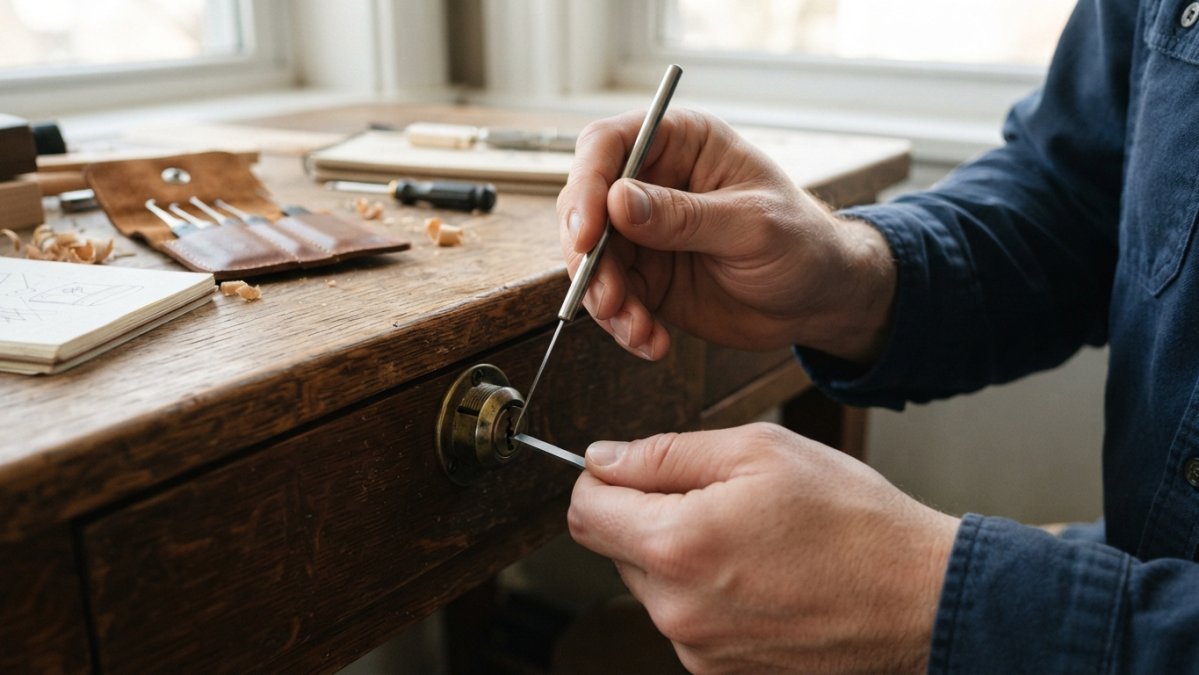
- Apply light tension. Insert the wrench and press in the direction the key would turn. Use barely any force. Too much tension pins the lock shut.
- Feel the pins. Slide your pick in and count the resistance points from front to back.
- Set pins one at a time. Push each pin up until you feel a small click, then move to the next.
- Rake if picking stalls. Insert the rake, apply light tension, and scrub in and out quickly.
- Turn the plug. Once all pins set, the cylinder rotates with gentle pressure.
Most simple cabinet locks open in under a minute with a rake. Stubborn ones may take several passes.
| Lock Type | Best Tool | Expected Difficulty | Typical Time |
|---|---|---|---|
| Wafer cam lock | Rake | Easy | Seconds |
| Basic desk lock | Rake or hook | Easy | Under a minute |
| Low-pin pin-tumbler | Hook pick | Moderate | A few minutes |
| Security cylinder | Hook pick | Hard | Skip it |
Non-Destructive Troubleshooting Before You Pick
Picking should be your second move, not your first. Many "locked" cabinets aren't locked at all.
Run this checklist first:
- Is the door actually latched? A warped wood cabinet can stick shut without any lock engaged.
- Is the cam misaligned? Open the adjacent drawer and reach behind to check.
- Is the keyway jammed? A shot of graphite lubricant frees a stuck cylinder more often than a pick does.
- Is there a bypass? Many cabinet locks can be removed from behind with a screwdriver.
Cabinet Lock Measurement and Compatibility
Cabinet lock measurement comes down to four numbers: cylinder diameter, cylinder length, cam length, and mounting hole size.
Measure with calipers if you have them. A ruler works for a rough check. Get the diameter wrong and the lock won't seat. Get the length wrong and the cam won't reach the frame.
Standard cam lock cylinders are commonly sold in a few fixed lengths. Match yours exactly.
Are Cabinet Locks Universal? What Fits and What Doesn't
No. Cabinet locks are not universal. Diameter, threading, cam length, and keyway orientation all vary between manufacturers.
What does transfer: keyway style and general picking technique. What doesn't: physical fit.
If you're replacing a lock, bring the old one to the store. If you're ordering online, match every dimension, not just the diameter.
For professionals who service cabinets daily, a reliable carry tool matters as much as the replacement lock. The Dyno Kwick Pick is built for exactly that kind of repeat work: pen-style, made in the USA, and designed for fast, discreet access when you're authorized to be there.
Frequently Asked Questions
How do you pick a file cabinet key?
File cabinet locks are usually simple pin-tumbler or wafer locks, which makes them some of the easiest to open with basic tools. Insert a tension wrench into the bottom of the keyway and apply light rotational pressure in the direction the key would turn. Slide a hook pick or rake to the back of the cylinder, then work it forward while maintaining tension. Many file cabinets open within seconds using a rake. If the lock has been damaged or the cylinder is seized, stop and call a locksmith rather than forcing it.
Are cabinet locks universal?
No. Cabinet locks vary widely in cylinder diameter, barrel length, mounting style, and cam shape, so a lock that fits one cabinet will often not fit another. The two most common cylinder sizes are 5/8 inch and 7/8 inch diameter, but length and cam offset matter just as much. Before buying a replacement, measure the existing lock's diameter, barrel length, and cam position, then match those specs. A lock that is close but not exact can bind, spin freely, or fail to engage the cabinet frame.
Is it possible to pick a lock with bobby pins?
Yes, bobby pins can work on simple cabinet locks in a pinch. Straighten one pin and bend a small hook at the tip to use as a pick, then bend a second pin into an L shape to serve as a tension wrench. Insert the tension wrench into the bottom of the keyway and apply light pressure, then rake or probe the pins with the hooked pin. Results are inconsistent because bobby pins are soft and lack the feedback of real tools, and they bend easily inside narrow keyways. For repeated work, a proper pick set or pen-style tool is far more reliable.
Can you install a cabinet lock without drilling?
Some cabinet locks install without drilling, including adhesive-backed cam locks, surface-mounted sliding locks, and child-safety strap locks. These work well for lightweight cabinets or temporary setups but offer limited security. For a standard cam lock that replaces an existing one, no new drilling is needed if the hole already matches the new lock's diameter and barrel length. Installing a cam lock in a cabinet with no existing hole requires drilling a hole sized to the cylinder, typically 5/8 inch or 7/8 inch, plus a smaller hole for the cam screw.
Locked out of your own cabinet and tired of bending paper clips? Dyno Kwick Pick gives you a pen-style 3-in-1 pick, rake, and tension tool that fits in a pocket and works on the simple locks most cabinets use. It's made in the USA by Sky Island Industries and backed by a satisfaction-first guarantee. Get started with Dyno Kwick Pick and keep a real tool on hand for the next stuck drawer.
0 commentaire