

Last Updated: November 4, 2026
Quick Summary
Lock pick attachment caps are small add-ons that clip a pick tool to a D-ring, paracord loop or key ring so it stays where you can reach it. The Kwick Pick Attachment Cap sells for $4.99 and is designed specifically for the Dyno Kwick Pick, so fit matters most.
- Confirm the cap is designed for your specific pick tool before buying, since a poor fit can let the tool shift or drop.
- Choose a D-ring for the most rigid anchor, paracord for the quietest carry, or a key ring for fast access with your keys.
- Test retention by shaking the assembly, letting it swing, and pulling the tool out with steady force.
- Re-check the cap fit after the first month, because polymer can wear and paracord can stretch over time.
Table of Contents
- What a Lock Pick Attachment Cap Does
- Matching the Cap to Your Pick Tool's Fit and Compatibility
- Carry Options: D-Ring, Paracord and Key Ring Attachment
- Retention, Comfort and Snag Risk in Everyday Carry
- Pocket Lock Pick Sets Versus a Capped Single Tool
- Lock Pick Accessories Worth Considering
- Lock Pick Legality Before You Carry
- Choosing Your Attachment Cap and Next Step
- Frequently Asked Questions
What a Lock Pick Attachment Cap Does
An attachment cap is a small add-on that gives a lock pick tool a secure anchor point. Instead of loose in a pocket or bag, the tool clips to a D-ring, paracord loop or key ring and stays where you can reach it. For attachment caps to matter at all, you first have to carry a pick tool every day, and that choice is where most people start.
Dyno Kwick Pick sells the Kwick Pick Attachment Cap for $4.99. It is built for the Dyno Kwick Pick and adds an anchor point for everyday carry. The practical question is whether that anchor actually improves your daily carry, so the checks below focus on that.
Matching the Cap to Your Pick Tool's Fit and Compatibility
Fit comes first. A cap designed for one tool may not seat correctly on another, so a loose or wobbly fit can let the tool shift or drop. The Kwick Pick Attachment Cap is described as designed specifically for the Dyno Kwick Pick, which is why compatibility matters more than any other spec.
Before you buy, confirm which pick tool you own. If you carry a different tool, check whether its listing names a compatible cap. Visit the Kwick Pick Attachment Cap page to review the product details, then compare them against your tool's dimensions. A well-fitting cap is quiet and snug. A poor fit rattles.

Carry Options: D-Ring, Paracord and Key Ring Attachment
The cap itself is only half the system. The attachment point you pair it with decides how the tool rides, how fast you can get to it, and how likely it is to be lost. Most guides list D-ring, paracord, and key ring as if they were interchangeable. They are not, and the differences show up within a week of daily carry.
D-ring. A metal or hard-plastic D-ring gives the most rigid anchor. It clips to a belt loop, a bag strap, or a lanyard and holds the tool at a fixed angle, so you can find it by feel without looking. The trade-off is bulk and hard edges: a D-ring on a belt loop can press into a hip when you sit, and a metal ring can clink against keys or a phone. A D-ring is the best choice if you wear a belt or carry a bag every day and want the tool to stay in one predictable spot.
Paracord. A paracord loop is light, quiet, and flexible. It lies flat against a pocket or bag and does not rattle, which makes it the least noticeable option in a pocket. The weakness is wear: paracord frays at the knot and at the point where it rubs against the cap, and a frayed loop can fail without warning. A common pattern is to melt or whip the ends and inspect the loop every few weeks. Paracord also stretches slightly over time, so a loop that starts snug can loosen.
Key ring. A split key ring keeps the tool with your keys, which is the one item most people already pat down before leaving. Access is fast because you are already reaching for keys, and the ring is cheap and replaceable. The downside is that keys are heavy and abrasive; a pick tool riding with a full keyring gets scratched, and the cap can work loose from the constant jostling. A key ring is the right pick if your keys are already your daily anchor and you do not mind some cosmetic wear.
A quick way to choose: match the attachment to the item you already check before you walk out the door. If that is your keys, use a key ring. If it is a bag, use a D-ring on the strap. If you carry neither, paracord on a belt loop is the lowest-profile compromise. Whichever you pick, attach the cap to the ring or loop first and then to the tool, so a single failed knot or clasp does not drop the whole assembly.
Watch out: a key ring that is already crowded can hide the tool among keys, which defeats the point of fast access. Keep the pick on its own small ring clipped to the main ring so you can separate it in one motion.
Retention, Comfort and Snag Risk in Everyday Carry
Retention is the reason a cap exists, but "more secure" is not a spec you can compare on a product page. What matters is how the cap holds the tool through the motions of a normal day: sitting, standing, reaching into a pocket, pulling out keys, and setting a bag down.
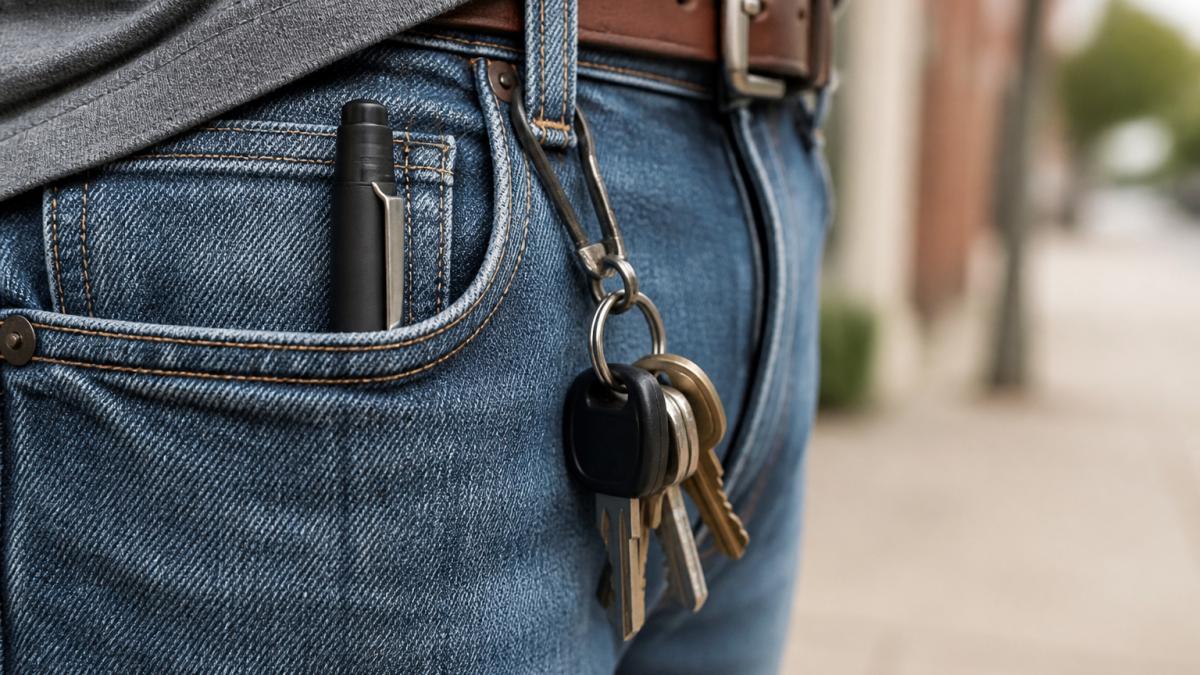
How retention actually fails. There are three common failure points. First, the cap-to-tool interface: if the cap seats loosely, the tool shifts inside it and can walk out over time. Second, the cap-to-ring connection: a split ring can open, and a paracord knot can slip. Third, the ring-to-anchor connection: a belt-loop clip can unsnap when you crouch or brush against a chair. A setup is only as strong as its weakest of the three, so check each one separately rather than trusting the assembly as a whole.
A simple retention check. Attach the tool the way you plan to carry it, then do a short routine: shake the assembly firmly for a few seconds, hang it from the anchor and let it swing, and pull the tool straight out of the cap with steady force. Then carry it for a full day and note whether the tool has shifted, the ring has opened, or the knot has loosened. Repeat after a week. This is a home check, not a lab test, treat it as a screen, not a guarantee.
Comfort and bulk. A capped tool adds length and a hard point to whatever it is attached to. On a belt loop, the cap can dig in when you sit; in a front pocket, it can press against a thigh; on a keyring, it adds swing and noise. The fix is usually placement, not a different cap: move the anchor to a bag strap or a rear belt loop and the same hardware becomes unnoticeable. If you carry in a pocket, a paracord loop lies flatter than a D-ring and is less likely to print through fabric.
Snag risk. The parts that catch are the ring, the clip, and any exposed knot or tag end. A ring that catches on a seat edge or a bag lining can yank the tool loose or tear fabric. Keep the profile low: trim paracord tails short, tuck knots under the loop, and avoid open clips that can hook a thread. Check the anchor after the first few days, if it has caught on something, move it before it costs you the tool.
Materials and wear. Caps are typically molded polymer, and the wear points are the seat where the tool enters and the eyelet where the ring passes through. Polymer can crack at the eyelet under repeated load, and metal rings wear through paracord faster than plastic ones. Wipe the cap dry if it gets wet, especially if you carry near salt or road spray, and inspect the eyelet and the ring for cracks, fraying, or elongation every few weeks. Replace a cap at the first sign of a crack rather than waiting for a failure. Learn how to maintain lock picks with a complete care guide to keep your tools in good condition.
Watch out: a cap that feels snug on day one can loosen as polymer wears and paracord stretches. Re-check the fit after the first month, not just at purchase.
Pocket Lock Pick Sets Versus a Capped Single Tool
A single capped tool keeps daily carry simple. A pocket set gives you more picks and rakes for different locks, but it takes more room and needs more organizing. Pick the option that fits how you actually work.
The Dyno Kwick Pick is priced at $20.50, and the Kwick Pick Set, which pairs it with the Dyno Stealth, is listed at $39.00. The Dyno Stealth is priced at $28.99 on its own. If you want one everyday tool, a single pick may suit you. Read the discreet everyday carry lock tools buyer's guide to compare options for carrying one tool. If you want coverage for smaller keyways, the set makes more sense.
| Option | Listed Price | Best Fit |
|---|---|---|
| Kwick Pick Attachment Cap | $4.99 | Owners of a compatible Dyno Kwick Pick |
| Dyno Kwick Pick | $20.50 | Everyday carry with a three-in-one design |
| Dyno Stealth | $28.99 | Smaller, more restrictive keyways |
| Kwick Pick Set | $39.00 | Standard and small keyways together |
| Dyno Kwick Pick Gift Set | $31.99 | Gifting or a presentation box |
Lock Pick Accessories Worth Considering
Beyond the cap, a few accessories can make daily carry easier. A replacement rake can be useful if you use a tool often. The Dyno Kwick Pick Gift Set includes a replacement rake insert and an engraved wooden presentation box.
Accessories should support the tool, not add clutter. Buy only what you will use in your normal routine. Browse must-have lock picking accessories for daily carry for a fuller list of extras.
Lock Pick Legality Before You Carry
Lock picking tools are subject to state and local rules that vary, and some jurisdictions restrict carrying them in certain circumstances. Before you carry a tool daily, check the rules where you live and work. Use lock picks only on locks you own or have permission to open.
We are not offering legal advice here. If you are unsure, a local attorney or your state's official code is the right place to confirm.
Choosing Your Attachment Cap and Next Step
Start with compatibility. Confirm that the cap fits the tool you carry, then choose the attachment point you will reach for daily. Check retention and snag risk, and decide whether a single tool or a set fits your needs.
The Kwick Pick Attachment Cap is a low-cost way to make an everyday pick tool easier to keep close. Review the option that suits your carry and compare the fit against your current tool before you order.
Frequently Asked Questions
Are lock picks illegal to carry in the US?
Laws on carrying lock picks vary by state and city, and some places treat possession with intent to commit a crime as an offense. Check your state and local statutes before carrying a pick tool daily, especially if you plan to use it on locks you do not own. Keeping the tool clipped to a pocket or keyring makes it easier to show it as a lock sport or locksmith tool if asked.
How do I know whether an attachment cap fits my Dyno Kwick Pick?
The Kwick Pick Attachment Cap is designed specifically for the Dyno Kwick Pick, so it is the correct match for that pen-style body. Before buying, confirm the tool you carry is the Dyno Kwick Pick and not a different pick set. The cap installs in seconds and adds a D-ring, paracord or key ring anchor point without changing the tool's low-profile body.
Is a pocket lock pick set better than a single capped tool for daily carry?
A single capped tool suits people who want one reliable pick in the pocket every day. A pocket set makes sense when you need a second pick for smaller keyways. The Dyno Kwick Pick Set pairs the Dyno Kwick Pick with the slim Dyno Stealth for $39.00, while the Dyno Kwick Pick alone starts at $20.50 and the Kwick Pick Attachment Cap costs $4.99 on its own.

0 comments