

Table of Contents
- What You'll Need: Tools and Practice Locks
- Best Lock Picks for Beginners: Choosing the Right Set
- Lock Picking Legal Status: What You Need to Know
- How Long Does It Take to Learn Lock Picking?
- Step-by-Step: How to Learn Lock Picking Safely
- Common Mistakes and Troubleshooting When You Get Stuck
- Maintaining Your Tools and Advancing Your Skills
- Frequently Asked Questions
Last Updated: September 28, 2026
What You'll Need: Tools and Practice Locks
Learning how to learn lock picking safely starts with the right equipment, not the most expensive. Cheap tools bend on the first attempt, so a basic kit needs just three things: a tension wrench, a short hook pick, and a clear practice lock.

Essential Picks, Tension Wrenches, and Practice Locks
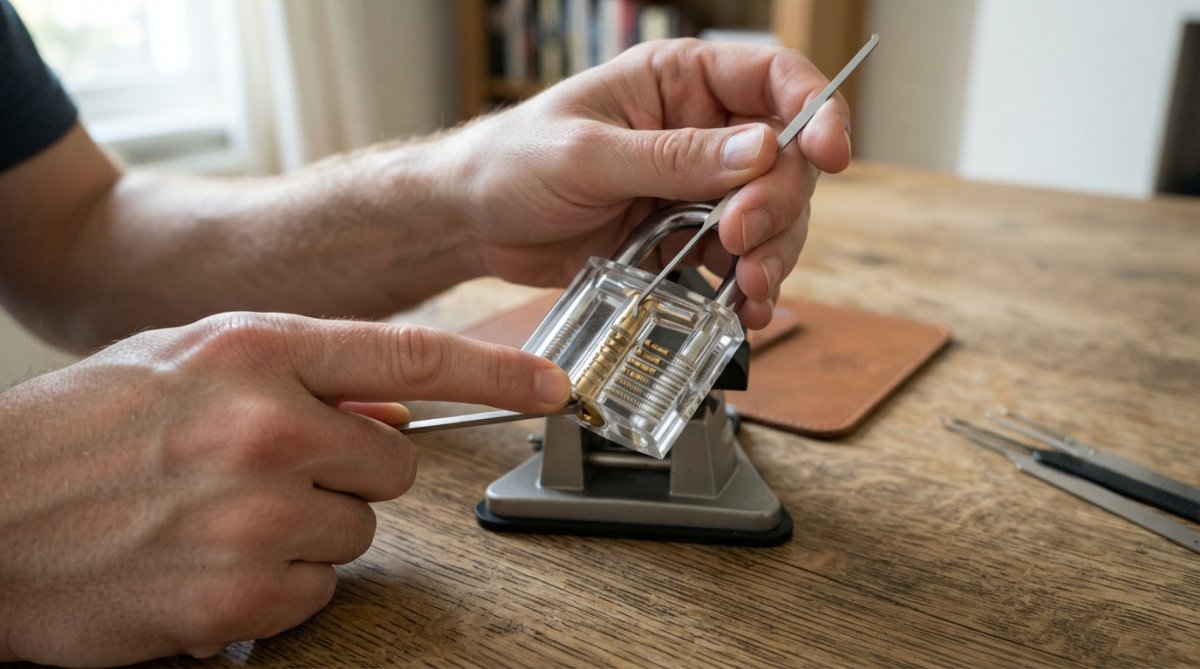
Start with a small set, not a 30-piece kit: a tension wrench that fits the keyway snugly, a pick hook for single pin picking, and a rake for speed practice. A transparent padlock shows every pin moving, shortening the learning curve.
Best Lock Picks for Beginners: Choosing the Right Set
- Tension wrenches: You need at least two, one top-of-keyway and one bottom, in different thicknesses.
- Hook profiles: A short hook covers 80% of beginner locks. A medium hook handles deeper bitting.
- Handle comfort: Bare steel digs into your fingers during long sessions.
- Case quality: Loose picks get lost or bent in a pocket.
A pen-style 3-in-1 tool like the Dyno Kwick Pick solves portability for people who want one discreet device instead of a roll-up case. It's made in the USA and built for daily practice.
Lock Picking Legal Status: What You Need to Know
Most guides wave at "check your local laws" and move on, useless when you're deciding whether to buy a set. Here's the framework that governs hobbyist lock picking, plus the ethical code that keeps you out of trouble where the law is silent.
The Two Questions That Decide Everything
Almost every state statute and local ordinance turns on two things: who owns the lock and what a reasonable person would infer from your intent. Tools are rarely the crime. Using them on someone else's property without authorization is.
- Owning picks: Legal in most states. A handful regulate possession more tightly, and some require a locksmith license for commercial work, charging money to open other people's locks.
- Carrying picks: Intent matters. Many states have a "burglary tools" statute that elevates possession to a crime when combined with intent to commit a crime. A pick set in your trunk is a different fact pattern than one in your pocket outside a locked building at 2 a.m.
- Using picks: Picking a lock you own, or have documented permission to open, is the safe zone. Picking a lock you don't own, even a friend's, is where hobbyists get cited.
Federal and State Layers You Should Know Exist
There is no single federal lock picking law for hobbyists, but federal rules restrict possession in specific contexts, such as certain federal property and in connection with other offenses. State law does the heavy lifting:
- Locksmith licensing: Several states license locksmiths and regulate who may perform lock work for compensation. To turn the hobby into income, that license, not your skill, is the gate.
- Burglary-tool statutes: These exist in most states in some form. They typically require intent plus possession, but the burden of explaining yourself falls on you.
- Local ordinances: Some cities add their own rules on carrying or selling picks. A state-level "it's legal" answer can still get you a citation downtown.
The Lock Picker's Code of Ethics
The law is the floor, not the ceiling. The locksport community runs on a stricter code:
- Never pick a lock you don't own. No exceptions for friends, family, or "it's basically mine."
- Get written permission for any lock you don't own. A text message counts. Verbal does not, because you can't prove it later.
- Never pick a lock that's in use. A lock securing a door, cabinet, or container is off-limits even if you own the container, because opening it may expose someone else's property or safety.
- Don't pick in public. Practicing in a coffee shop or parking lot invites exactly the wrong interpretation of your intent.
- Don't teach someone who won't follow the code. Sharing technique with someone who plans to use it on other people's property makes you part of the problem.
- Keep your tools out of sight in transit. A locked case isn't paranoia; it's evidence of responsible intent if you're ever asked.
Practice Scenarios That Are Always Safe
- Locks you bought and own outright.
- Practice cylinders and cutaway locks.
- Locks belonging to a locksport club or sanctioned event where ownership and permission are established.
- Locks on property you control, with no one else's belongings behind them.
If a scenario doesn't fit one of those, treat it as off-limits until confirmed otherwise. The hobby is legal and rewarding, but only for people who treat ethics as seriously as technique.
How Long Does It Take to Learn Lock Picking?
Most beginners open their first standard-pin lock within a few hours of focused practice, and reach consistent single pin picking on basic cylinders in a few weeks. Mastery of security pins and high-security mechanisms takes months.
| Skill Level | Typical Timeline | What You Can Open |
|---|---|---|
| First open | 1-3 hours | Single-pin clear practice lock |
| Basic proficiency | 2-4 weeks | Standard 5-pin cylinders |
| Intermediate | 2-3 months | Locks with spool or serrated pins |
| Advanced | 6+ months | High-security and dimple locks |
Step-by-Step: How to Learn Lock Picking Safely
Safe learning means controlled conditions: your own locks, clear feedback, and light tension. Rushing the fundamentals develops habits that stall progress for months.
Step 1: Start with Clear Practice Locks and Basic Tension
Insert your tension wrench and apply light pressure, just enough to feel resistance, too much binds every pin at once and kills the feedback you need. Insert your hook and feel for the binding pin, the one that resists first. With a clear lock, watch the pins to connect feel to visual.
Step 2: Master Single Pin Picking and Feedback
Single pin picking (SPP) means lifting one pin at a time to the shear line: apply tension, find the binding pin, lift until you feel a click, then move on. Counter-rotation on a spool pin feels like the plug pushing back against your wrench, your cue to ease tension and let the pin set.
Step 3: Progress to Security Pins and Real Locks
Once standard pins feel predictable, move to spool pins and serrated pins, which create false sets that trick you into thinking a pin is set. Practice on a repinnable lock to rearrange pins and drill specific scenarios, then graduate to real locks you own.

Common Mistakes and Troubleshooting When You Get Stuck
Every beginner hits the same wall: the lock won't open and you don't know why. Most guides stop at "use less tension." Here's a diagnostic sequence that tells you which problem you have.
Lock Picking Book - Beginners Visual →
The Troubleshooting Flowchart
Work through these in order and stop at the first match.
1. Does the plug rotate at all, even a hair?
- No rotation, no clicks: Tension is too light, or your wrench isn't seated. Re-seat it and add pressure until you feel the plug resist.
- Rotation but no pins set: Tension is too heavy, so every pin binds at once. Ease off until only one pin resists your hook.
2. Do you feel a pin resist, but lifting it does nothing?
- The pin is already set. Move to the next binding pin. Re-checking a set pin is the most common wasted motion for beginners.
- You're lifting at the wrong angle. The hook tip should push the pin straight up, not sideways, or it pushes into the chamber wall instead of the shear line.
3. Did a pin click, then the plug rotated further, then everything locked up?
- You hit a false set. This is normal on spool and serrated pins: the plug rotated because the spool's narrow waist let it, but the pin isn't set. Apply light counter-rotation and feel for the pin to push back against your wrench, that's the spool telling you it's ready to set.
4. Did the plug rotate partway and then stop hard?
- You have an overset pin. You lifted a pin past the shear line. Release tension slightly, let it drop back, then re-find the binding pin. Forcing it bends hooks and damages springs.
5. Does the pick feel like it's about to bend?
- Stop immediately. A stuck pin plus heavy tension equals a bent hook. Reset: remove the pick, release tension, re-seat the wrench, and start the binding sequence from scratch.
Why Your Lock Isn't Opening: The Five Real Causes
If the flowchart didn't isolate it, the problem is almost always one of these:
- Tension control. Too much tension is the number-one cause of failure at every skill level. The correct pressure is lighter than most beginners believe, just enough to feel one pin bind.
- Binding order confusion. Pins don't set 1-2-3-4-5; they set in the order the cylinder's tolerances make them bind. Forcing pin one when pin three is the binder will never open it.
- Wrong hook profile. A short hook handles most standard cylinders, but deep bitting or tight warding may need a medium or deep hook.
- Worn or dirty lock. A lock sitting for years may have gummy pins. A drop of lock lubricant (graphite or purpose-made lock lube, not WD-40) can restore feedback.
- Security pins you didn't know were there. If a lock keeps false-setting and never opens, it likely has spool or serrated pins. Switch to counter-rotation technique.
The Reset Drill
When stuck and frustrated, don't keep picking. Instead:
- Remove the pick and tension wrench.
- Set the lock down for 60 seconds.
- Re-insert the tension wrench and apply lighter pressure than before.
- Find the binding pin by feel only, don't look at the lock if it's clear.
- Lift slowly until you feel a click, then move on.
The reset drill works because frustration causes tension creep: your hand tightens unnoticed and every pin binds.
Maintaining Your Tools and Advancing Your Skills
Pick care is simple: wipe steel after handling, store picks flat in a case, and inspect tips for burrs. A bent hook transmits false feedback and teaches bad habits.
Frequently Asked Questions
Is it illegal to learn how to lockpick?
Lock picking legal status varies by state and local laws in the United States. Many states restrict possession of lock picks to licensed locksmiths or require a permit for certain tools. Learning the skill itself is generally not illegal, but using it on property you don't own is. Always check your state and local regulations before buying tools or practicing.
What tools do I need to start lock picking?
You need a basic pick set with hooks and rakes, a tension wrench, and at least one practice lock. The Lock Picking Book - Beginners Visual Guide offers step-by-step diagrams to help you understand each tool. Start with a clear practice lock so you can see the pins move, then add a repinnable cutaway lock for advanced practice.
How long does it take to learn lock picking?
Most beginners can open a standard pin tumbler lock within a few hours of practice. Basic proficiency takes weeks of regular practice, while mastering security pins like spools and serrated pins may take months. Using progressive practice locks and following a structured guide can speed up your learning significantly.
Can I practice lock picking on my own locks?
Yes, practicing on your own locks is legal and encouraged. Use a dedicated practice lock or a lock you own outright. Avoid picking locks on rental property or any lock you don't have permission to touch. Clear practice locks let you see the binding order and shear line, making learning faster and safer.
0 comments